

Global Business Models & Financial Infrastructure
While considering the context of working global business models with a dedicated financial infrastructure, it could contribute to a centralized operations workflow. CFOs can evaluate and ensure the authentication of this system with a dynamic cross-border payments solution model. The core idea here is to accommodate multiple systems and services that can enable a strategic framework within the organization. Guided use of digital payment solutions can help businesses and key decision-makers in this regard. The underlying principle in such scenarios can enhance the key personnel to take active action regarding the payments workflow.
The Competitive Advantage of a Decisive Cash Flow
The competitive edge offered by organized cash flow to businesses is beyond comparison. It could cause the development of strategies to empower business models. From a CFO’s perspective, this could sum up to functions such as superior agility, payment timing parameters, long-term investment moats, resilient and disciplined cash flow forecasting, and identification of massive supply chain power. CFOs can convert the company’s payments infrastructure into a proactive model with dedicated steps in this case. It could open up further liquidity opportunities for businesses, offering a better cash position.
Expectations of Financial Control in Growth & Technology
Gone are the days of financial control depending on compliance-based services alone. Nowadays, the focus is more on revenue recognition and strategy. The growth and technology sector widely adopts this notion by building an emphatic structure with defined deliverables. Continuous funds flow and monitoring are possible in this model. The contextual application of payment solutions will give rise to global business expansion measures without compromising the fundamental compliance objectives. In the hands of a CFO who stays on top of his craft, the overall workflow optimization within the organization becomes easier to follow and adapt. With an acceptable data governance model, the CFOs can enable credibility for their organization’s systematic growth with essential analytics flow and decision-making procedures.
Why CFOs Should Focus on Embedded Finance & Cross-Border Solutions
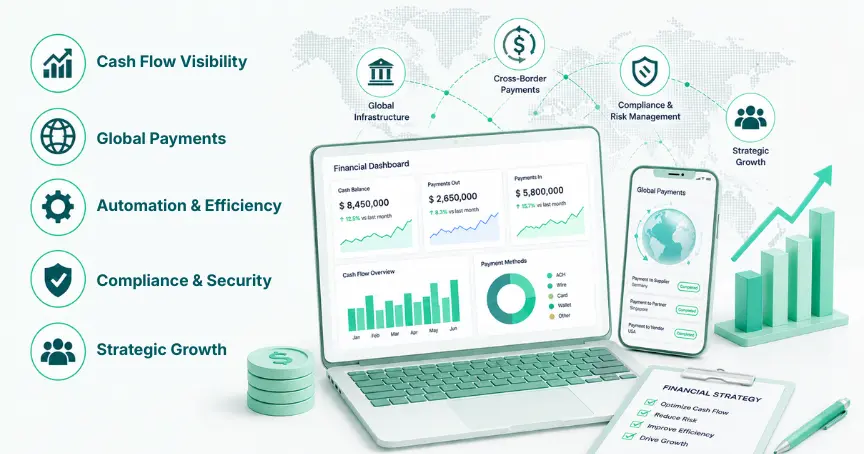
CFOs can deliver optimum solutions in the cross-border payments platform to facilitate a dynamic global operations model. Real-time cash flow visibility and automated compliance workflow are active features that can elevate the value of business models adopting this format.
With the advent of newer integrations in the domain of borderless transactions, the impact created by embedded finance on a global scale will rise. CFOs can ensure quality support in these integrations with ease. It could also pave the way for creating solutions in proactive risk management and frictionless trade prospects.
Conclusion: Paywint’s Role in Helping CFOs Evaluate & Implement Fintech Support
Once you have understood what contributes to a business development policy in terms of financial transactions and monetary control from a CFO’s end, the whole dynamics will change. With Paywint at its disposal, a business can empower its fintech activities with a unified payment platform that is supposed to operate with greater efficiency and cost optimization coefficients. CFO’s will get the luxury to accommodate multiple providers, faster transactions, and effective payment insights in one strategic line.
Frequently Asked Questions
What is the role of a CFO in modern financial operations?
Today's CFO is responsible for driving strategic growth through cash flow optimization, risk management, financial visibility, and operational efficiency, beyond traditional accounting and reporting. Paywint helps CFOs streamline global payment operations with secure, automated financial infrastructure that supports smarter business decisions.
Why are cross-border payments important for CFOs?
Efficient cross-border payments improve cash flow, reduce transaction costs, strengthen supplier relationships, and enable businesses to expand into international markets with confidence. Paywint simplifies cross-border payments through a unified platform designed to give CFOs greater control, transparency, and speed.
How can CFOs improve cash flow management?
CFOs can strengthen cash flow by accelerating collections, automating payment processes, reducing settlement delays, and gaining real-time visibility into company funds. Paywint empowers finance teams with modern payment solutions that help optimize liquidity and improve working capital management.
How does payment automation benefit finance teams?
Payment automation reduces manual processing, minimizes errors, speeds up reconciliation, and allows finance professionals to focus on higher-value strategic initiatives. Paywint automates business payment workflows to improve efficiency, accuracy, and financial control across global operations.
Modern Payment Solutions v/s Paywint from A CFO’s Perspective
| Capability or Feature | Modern Solutions | Paywint |
|---|---|---|
| Scalability | Suitable for growing entities | Built with enhanced support for different countries and corridors |
| Cash Flow Optimization | Faster processing rates | Designed for streamlined liquidity and funds flow |
| Treasury Liquidity | Basic reporting support | Actionable insights and real-time visibility |
| Financial Control | Standard reporting and approval | Centralized control of workflow records |